Digitally set up & present nationwide
Your lawyers for your finances
Digitally set up & present nationwide
Your lawyers for your finances


Corinna D. Ruppel (LL.M.)
Your lawyer for Banking, Capital Markets and Inheritance
A debit you never authorised. A transfer to fraudsters, a credit card emptied out, a trading platform that will no longer pay out your deposit. The shock is considerable – but your money is not automatically lost. In many cases the law obliges banks to reimburse you, and for almost every payment method there is a regulated route to recovery. Two things matter now: taking the right steps quickly and not letting any deadlines pass.
Contents of the article
Which deadlines are running in your case, which obligations have you already met, which legal questions are open? The fraud check asks you six to eight questions about the incident and then sorts what you have told it: deadlines that are running, obligations and open legal questions – free, anonymous and without any assessment of the outcome.
The perpetrators are usually based abroad and the money has been moved through intermediary accounts. A criminal complaint is important – as a rule it does not bring the money back. The legally regulated route runs via your bank:
Who is liable when, in detail: liability in online banking fraud and credit card fraud: who is liable?.
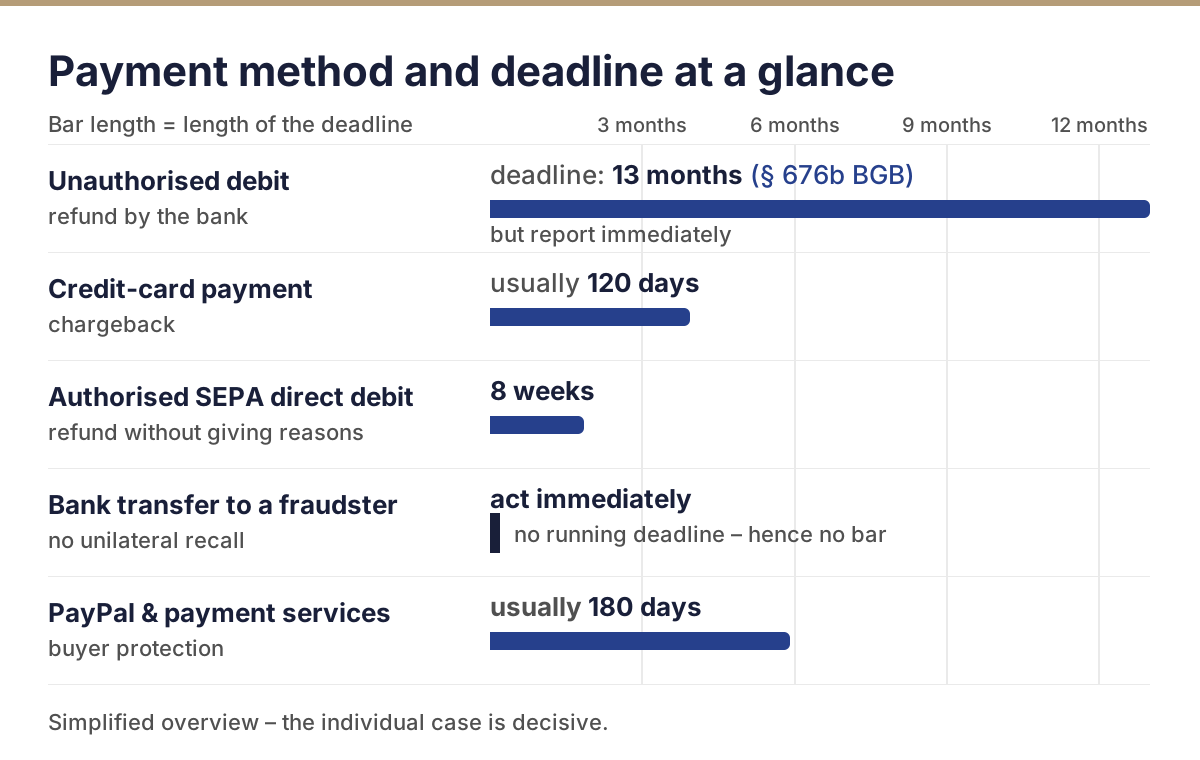
| Payment method | Route to recovery | Deadline |
|---|---|---|
| Unauthorised debit (account/card) | reimbursement by the bank (§ 675u BGB) | notification at the latest 13 months after the debit (§ 676b BGB) – but: report it without delay! |
| Credit card payment to fraudsters | chargeback via the card-issuing bank | depending on the card scheme, usually 120 days – how it works |
| Authorised SEPA direct debit | refund without giving reasons | 8 weeks from the debit |
| Unauthorised direct debit | reimbursement by the bank | 13 months (§ 676b BGB) |
| Bank transfer to fraudsters | no unilateral recall; contact with the recipient bank, suspicion of money laundering, civil-law claims | act immediately – bank transfer fraud |
| PayPal and payment services | buyer protection (above all for purchases of goods) | depending on the service, usually 180 days |
| Payment into a trading or crypto platform | claims against those involved, chargeback where payment was made by card | depends on the individual case – see below |
This overview reflects the routes provided for by law and is deliberately simplified. Which route is actually open, and how promising it is, always depends on the specific individual case – and that is precisely where the dispute begins in practice.
Almost every refusal rests on the same allegation: that you acted with gross negligence because you released the TAN yourself or clicked on a link. Two things generally speak against that – although the assessment always depends on the individual case:
First, the yardstick. According to the Federal Court of Justice, gross negligence is an "objectively serious and subjectively quite simply inexcusable" breach of the duties of care (BGH XI ZR 91/14). Falling for professionally executed phishing – a deceptively genuine bank page, a supposed employee on the telephone, manufactured time pressure – does not automatically meet that threshold. It depends on the precise circumstances of the individual case, and in many cases those affected are nevertheless held partly at fault.
Second, the burden of proof. It is not for you to prove that you took care – the bank must prove your gross negligence (§ 675w BGB). Blanket assertions ("the PIN was used, so it must have been you") are generally not enough for that.
How the scams work in detail and what each of them means legally: phishing · pushTAN fraud · hacked account · all scams at a glance.
A refusal is not the end of the road, but it is also not unusual – banks frequently rely on contributory fault or gross negligence on the customer's part, and that assessment is not always wrong from the outset.
With fraudulent investments (fake trading platforms, "brokers" who refuse to pay out, crypto investments with advance costs), recovery works differently: here you have usually transferred the money yourself, so § 675u BGB generally does not help directly. What may come into consideration is a chargeback where payment was made by card, as well as claims against the payment service providers and accomplices involved. Claims against your own bank do not generally exist in this context simply because payments went to fraudulent recipients – not even where conspicuous features are recognisable in hindsight. Where the money has been transferred abroad, experience shows that recovering it from Germany involves considerable practical obstacles and is difficult to enforce in many cases. Which routes are open in an individual case depends heavily on the payment method and on the timing.
A warning about the second fraud: "recovery agencies" that promise to track down lost money against advance payment are almost always the next fraud – often the same perpetrators. Reputable legal enforcement never works with advance-payment promises of that kind.
Many legal expenses insurance policies cover disputes with the bank – what legal expenses insurance pays in cases of internet fraud is something we have written up separately. Insured or not: lawyer Corinna Ruppel will look at your case in a free initial consultation – you will learn which claims come into consideration, which deadlines are running and what enforcement would cost, before you decide. More about representation: lawyer for online banking fraud · for credit card fraud · for bank transfer fraud.
Note
The fraud check and this page provide general information about the legal position in Germany (as at August 2026). They do not replace individual legal advice; whether claims exist in an individual case, and in what amount, can only be assessed on the basis of the documents.
Lawyer Corinna Ruppel represents victims of phishing, credit card and bank transfer fraud as well as investment fraud against banks and payment service providers. View profile
Further reading: Credit card fraud – an overview · Online banking fraud – an overview · Credit card fraud: what to do? · The bank will not pay
Possibly. A release obtained by deception is not automatically an authorisation, and the bank must prove gross negligence – measured against the Federal Court of Justice's yardstick of "quite simply inexcusable" (XI ZR 91/14). It depends on how the deception unfolded and which circumstances applied in the individual case.
Not without more. The Federal Court of Justice has held that the correct use of a PIN or TAN alone generally proves neither the authorisation nor gross negligence (XI ZR 107/22). As a rule the bank needs more than the technical sequence of events – what is required specifically depends on the individual case.
In the case of an unauthorised payment: without delay, at the latest by the end of the business day following your notification (§ 675u BGB). It may continue to investigate afterwards – but in principle it must reimburse first.
The absolute limit is 13 months from the debit (§ 676b BGB). Even so, do not wait: you are obliged to give notice without delay (§ 675l BGB), and every day makes the money harder to trace.
You cannot unilaterally revoke a transfer that has been executed (§ 675p BGB). What remains: immediate contact with the recipient bank via your own bank, freezing the money if it is still there, and civil-law claims against the recipient.
Reimbursement under § 675u BGB does not depend on the amount, and the route via an objection and the conciliation body costs nothing. From what order of magnitude legal enforcement is worthwhile can be clarified in the first conversation – another question of costs that you get in black and white beforehand.
The bank's obligation to reimburse does not require a criminal complaint. In practice, however, banks almost always ask for the file reference, and the complaint matters for the investigation and for securing evidence.
Corinna D. Ruppel (LL.M.) advises and supports you in banking law, inheritance law and capital market law. Lawyer Ruppel is a specialist in checking, enforcing and defending against claims. Ms. Ruppel has been the owner of CDR Legal since 2013 and has already provided over 9,000 initial meetings and represented more than 2,000 clients.