Digitally set up & present nationwide
Your lawyers for your finances
Digitally set up & present nationwide
Your lawyers for your finances


Corinna D. Ruppel (LL.M.)
Your lawyer for Banking, Capital Markets and Inheritance
Have you been disinherited or passed over in the will? Then you are generally entitled to the compulsory portion: half of the statutory share of the inheritance, as a monetary claim against the heirs. Our calculator shows you your compulsory-portion quota in no more than eight questions – free, anonymous and non-binding.
Contents of the article
Three groups of people are generally entitled to the compulsory portion: the descendants of the testator, that is first and foremost the children – and where a child has died before the testator, that child's own children (the testator's grandchildren) take their place. In addition, the spouse or registered civil partner is entitled to a compulsory portion. The parents of the testator, by contrast, only come into play if there are no descendants at all.
Adopted children are fully equal to biological children. Stepchildren without adoption, siblings, divorced spouses and unmarried partners, on the other hand, have no claim to a compulsory portion – regardless of how long the relationship lasted.
The claim arises where you have been excluded from the succession by a will or an inheritance contract. Anyone who receives too little can also demand an additional compulsory portion (§ 2305 BGB). More on this: compulsory portion despite a will.
| Constellation | Statutory share | Compulsory-portion quota | Example: estate of €300,000 |
|---|---|---|---|
| 1 child, testator widowed/unmarried | 1/1 | 1/2 | €150,000 |
| 2 children, widowed/unmarried | 1/2 each | 1/4 each | €75,000 each |
| 1 child + spouse (community of accrued gains) | 1/2 | 1/4 | €75,000 |
| 2 children + spouse (community of accrued gains) | 1/4 each | 1/8 each | €37,500 each |
| 3 children + spouse (community of accrued gains) | 1/6 each | 1/12 each | €25,000 each |
| Spouse alongside children (community of accrued gains) | 1/2 | 1/8 or 1/4* | €37,500 or €75,000 |
* For spouses there are two ways of calculating – the "large" and the "small" compulsory portion (§ 1371 BGB), see below. Different quotas apply under separation of property and under community of property; the calculator above takes the matrimonial property regime into account automatically.
How large the children's share is in further constellations is shown in our articles on the compulsory portion for children, on the compulsory portion for grandchildren and on why siblings have no compulsory portion.
Starting point: Mr M. dies and leaves behind his wife (community of accrued gains) and two children. His will appoints the wife as sole heir; the daughter is disinherited.
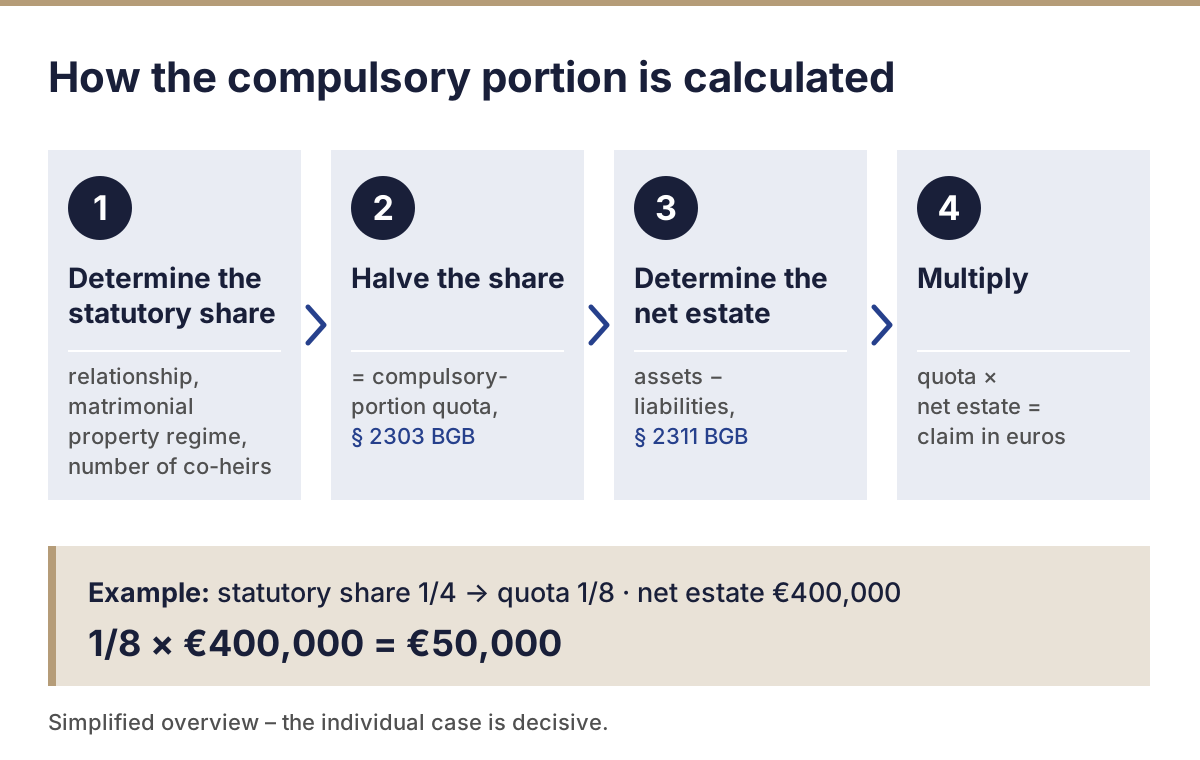
Step 1 – quota: Without a will, the daughter would have inherited 1/4 (wife 1/2, the two children 1/4 each). Her compulsory-portion quota is half of that: 1/8.
Step 2 – estate: House €300,000 + accounts and securities portfolio €120,000 = €420,000, less an outstanding loan of €15,000 and funeral costs of €5,000 = net estate €400,000.
Step 3 – compulsory portion: 1/8 × €400,000 = €50,000.
Step 4 – gift: Four years before his death, Mr M. had given his son €80,000. Under the meltdown rule, 70 % of that is still taken into account, i.e. €56,000. The supplemented estate amounts to €456,000, and the daughter's total claim to 1/8 of it = €57,000. Her claim to a supplementary compulsory portion: an additional €7,000 (§ 2325 BGB).
What matters is the value of the estate on the date of death (§ 2311 BGB): real estate at market value, accounts, securities portfolios, shareholdings, household effects and vehicles – less the debts of the testator, the funeral costs and the costs of administering the estate. Legacies and testamentary obligations arising from the will are not deducted.
In practice, property values are what is argued about most often. As a person entitled to a compulsory portion, you can demand an expert valuation at the expense of the estate. What applies where real estate forms part of the estate, and how a usufruct affects the compulsory portion, we explain in separate articles.
You do not know the value of the estate? That is the normal case – and this is precisely what the right to information is for: the heirs must present you with a complete inventory of the estate, and on request one drawn up by a notary (§ 2314 BGB). The estate bears the costs. Details: the right to information for the compulsory portion, and incorrect information in the estate inventory.
If the testator gave assets away during his lifetime, the compulsory portion is calculated as if the gift still belonged to the estate (§ 2325 BGB). The meltdown rule applies: for every full year since the gift was made, it counts 10 % less.
| Time since the gift | Proportion taken into account |
|---|---|
| in the 1st year before the inheritance | 100 % |
| 2nd year | 90 % |
| 3rd year | 80 % |
| 4th year | 70 % |
| 5th year | 60 % |
| 6th year | 50 % |
| 7th year | 40 % |
| 8th year | 30 % |
| 9th year | 20 % |
| 10th year | 10 % |
| older than 10 years | 0 % |
Two important exceptions: for gifts to a spouse, the ten-year period only begins when the marriage is dissolved – and where the testator reserved a usufruct for himself, it generally does not begin to run at all. Particularly where real estate has been transferred, there is therefore often more to be had than it first appears.
For a disinherited spouse in a community of accrued gains there are two ways of calculating (§ 1371 BGB): the small compulsory portion (1/8 alongside children) plus the equalisation of accrued gains as actually calculated – or the large compulsory portion (1/4), where the inheritance is disclaimed or no equalisation of accrued gains can be demanded. Which route is more favourable depends on how much accrued gain actually arose during the marriage. This is one of the points at which the calculator deliberately stops and a look at the documents becomes necessary. More on this: the large and the small compulsory portion for spouses.
The claim to a compulsory portion becomes time-barred after three years (§§ 195, 199 BGB). The period begins at the end of the year in which you learned of the inheritance and of your disinheritance.
Example: You learn of the death and of the will in March 2026. The limitation period begins on 31 December 2026 and ends on 31 December 2029. After that, the heirs can refuse payment – even where the claim did in fact exist. What suspends the period and which special periods exist: limitation of the compulsory portion.
The calculator determines your quota reliably for the most common family constellations. It reaches its limits where the individual case governs the calculation – typical examples are:
In these cases, a free initial consultation with lawyer Corinna Ruppel can help you get your bearings and discuss the possible next steps. You will also find more in-depth information in the article claiming a compulsory portion with legal support. How enforcement proceeds step by step is shown in our article on claiming the compulsory portion.
Note
The compulsory portion calculator and this page provide general information about the legal position in Germany (as at August 2026). They do not replace individual legal advice. We accept no liability for the accuracy of the calculation in an individual case – the calculator cannot reflect special features such as a waiver of the compulsory portion, set-offs or assets abroad.
Lawyer Corinna Ruppel (LL.M.) represents clients in inheritance law, with a focus on enforcing claims to a compulsory portion and claims to information. View profile
Further reading: The compulsory portion – an overview · Calculating the compulsory portion yourself: the method in detail · Concealed inheritance · Contesting a disinheritance
Yes. Under a Berlin will, the surviving spouse initially inherits alone – the children are disinherited for the first inheritance and can demand their compulsory portion. Be careful where there is a compulsory-portion penalty clause: whoever makes a demand is then often reduced to the compulsory portion on the second inheritance as well. Whether it is still worth it depends on the financial circumstances.
Yes. The compulsory portion is not paid out automatically, and the probate court does not determine it. You have to assert the claim against the heirs yourself – first with a request for information, then quantified.
The compulsory portion is a monetary claim – how the heirs raise it is their business. If they cannot pay, a deferral may be considered in narrow exceptional cases; in practice, payment by instalments or financing secured on the property is often agreed.
Only if the testator ordered them to be set off when making the gift (§ 2315 BGB). Without such an order, your compulsory portion is unaffected – a point that heirs often misjudge. Please note: different rules apply to the claim to a supplementary compulsory portion under § 2325 BGB; there it does not depend on an order to set off.
No. Stepchildren without adoption and divorced spouses are not entitled to a compulsory portion. Biological and adopted children, by contrast, are always entitled – as are children born outside marriage.
The costs depend on the individual case. A flat fee, billing under the German lawyers' fees act (RVG) or an hourly rate are all conceivable – what fits in a specific case can be discussed in that first, no-cost conversation.
Corinna D. Ruppel (LL.M.) advises and supports you in banking law, inheritance law and capital market law. Lawyer Ruppel is a specialist in checking, enforcing and defending against claims. Ms. Ruppel has been the owner of CDR Legal since 2013 and has already provided over 9,000 initial meetings and represented more than 2,000 clients.